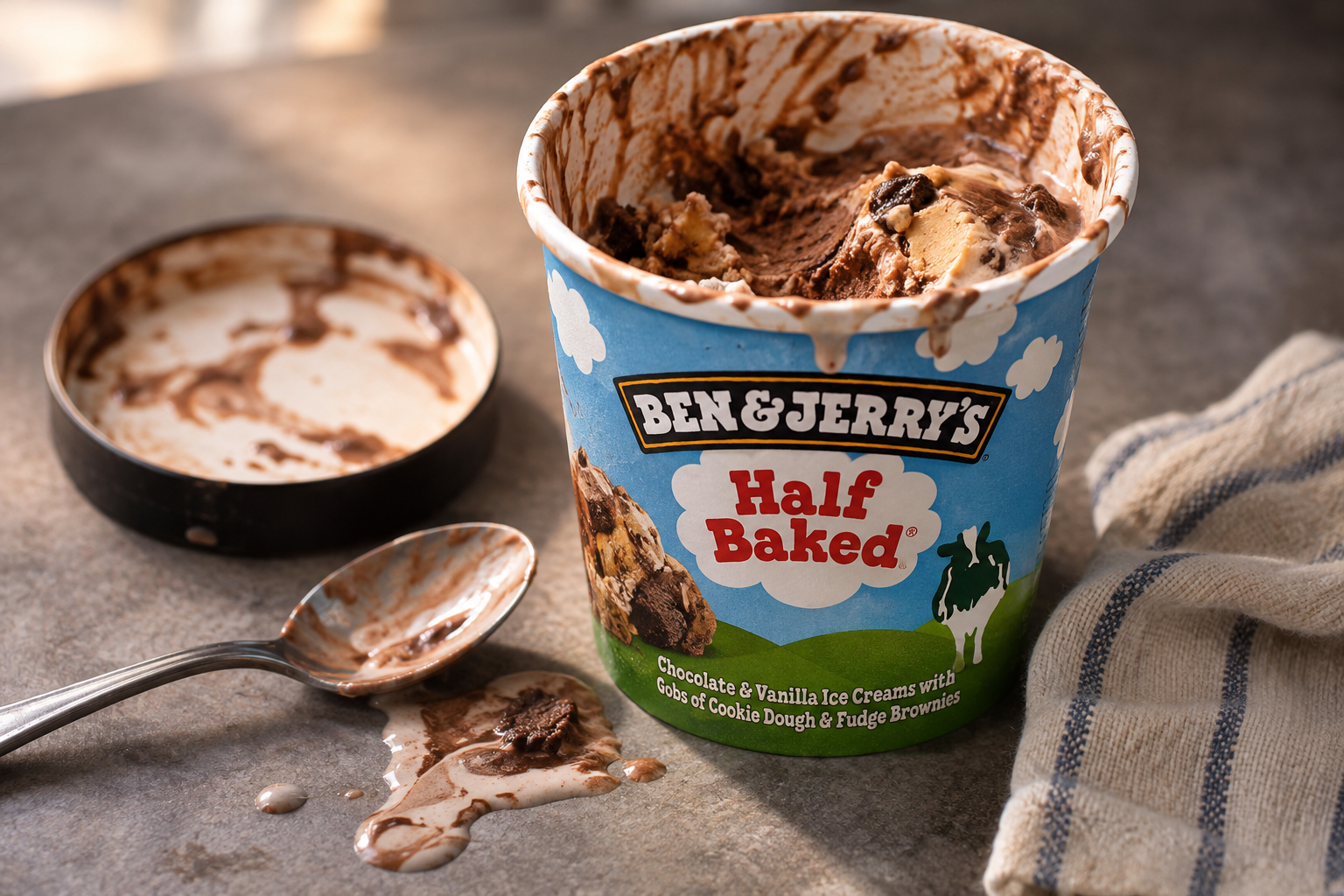
I Ate the Whole Thing
On ice cream, emotions, and the decisions we know better than to make.
I love chocolate.
The other night, I had a craving for ice cream. Not just any ice cream. Ben & Jerry's Half Baked. Chocolate and vanilla ice cream with chunks of cookie dough and fudge brownies. One of my favorites. What's not to love?
So I went out, bought a pint, came home, and settled in to enjoy it.
I ate the whole thing.
Now, I'm a reasonably intelligent guy. I know perfectly well that eating an entire pint of Ben & Jerry's isn't a particularly good idea. It's a gazillion calories, loaded with sugar, and like most people my age, I'm trying to be mindful of my waistline. Not to mention my A1C, since I'm pre-diabetic.
But knowing better and doing better are two very different things.
And here's the best part.
About halfway through, I somehow managed to drop the pint. It slipped out of my hands, spilling partially melted ice cream down the front of my shirt, into my lap, and finally onto the floor.
A reasonable person might have interpreted this as a sign from the universe. Enough already.
Not me.
I scrambled to pick it up before the cats got to it, assessed the remaining contents, and continued eating. Every last spoonful.
I tell you this story not because I'm particularly proud of my behavior, but because it illustrates something about human nature worth examining.
We all do things we know we probably shouldn't.
We know better. We understand the consequences. We may even recognize, while we're doing it, that we're making a questionable decision.
And we do it anyway.
Sometimes the consequences are relatively harmless. A few extra calories. A stained shirt. A little regret the next morning.
But what happens when the stakes are higher? When our decisions involve our careers, our businesses, our finances, or our relationships with other people?
The same human tendencies that lead us to make questionable decisions about ice cream can have far more serious consequences when the decisions really matter.
What Is Real vs. What We Feel
When we're dealing with other people, particularly when things become personal, our emotions can influence not just how we react, but how we interpret what's happening in the first place.
Someone says something that upsets us. A business partner makes a decision without consulting us. A family member behaves in a way we find hurtful. A colleague takes credit for something we believe we contributed to.
Those are events. Things that happened. But almost immediately, we begin constructing a story around them.
He doesn't respect me.
She's deliberately trying to undermine me.
They've been taking advantage of me for years.
This proves what I've suspected all along.
Maybe those interpretations are correct. Maybe they're not.
The problem is that we often stop distinguishing between what actually happened and what we've concluded it means.
Our feelings become evidence. Our assumptions become facts. And the story we've told ourselves becomes our version of reality.
We begin confusing what we know with what we feel.
This doesn't mean our emotions are wrong or unimportant. Quite the opposite. Emotions can alert us to something that deserves attention.
But feeling disrespected isn't necessarily proof that someone intended to disrespect us. Feeling threatened doesn't necessarily mean we're in danger. And feeling certain doesn't necessarily mean we're right.
The distinction matters, particularly when we're about to make a decision that could have lasting consequences.
It's one reason I've written before about Why Smart People Make Bad Decisions Under Pressure. Intelligence and experience don't necessarily protect us from the influence of emotion.
The Spiral
Once we've settled on our interpretation of events, something else often happens.
We start thinking about it. A lot.
We replay conversations in our heads. We remember other incidents that seem to support our conclusions. We imagine what the other person must be thinking, what they're likely to do next, and how we're going to respond.
We may talk to friends or family members who, understandably, want to be supportive. They hear our version of events and reassure us that we're right.
And so the story becomes stronger.
What started as an upsetting event becomes a much larger narrative about the other person's character, motivations, and intentions.
The more we think about it, the more upset we become. And the more upset we become, the more convinced we are that our interpretation is correct.
It's a feedback loop.
We can spend an enormous amount of time thinking about a situation without actually gaining any clarity about it.
In fact, we may be moving in precisely the opposite direction.
The Urgency to Do Something
Then comes what I consider one of the most dangerous moments in a consequential conflict or decision.
We feel compelled to act.
We've thought about the situation endlessly. We've convinced ourselves that we understand what's happening. We're frustrated, angry, hurt, or anxious. And we want to do something about it. Now.
Send that email. Make that phone call. Confront that person. Issue that ultimatum. Walk away from the relationship. Fire the employee. Dissolve the partnership.
Sometimes action is absolutely necessary. And sometimes it really is urgent.
But often, the urgency we're experiencing has less to do with the actual circumstances than with our desire to relieve the emotional discomfort we're feeling.
We confuse the urgency of our feelings with the urgency of the situation.
That's when things can go badly wrong.
An angry email can't always be taken back. An accusation can permanently damage trust. An ultimatum can eliminate options that might otherwise have remained available.
And a decision made to feel better in the moment can leave us considerably worse off in the long run.
This is why I believe so strongly in Clarity Before Escalation. Before deciding what to do, we need to make sure we understand what's actually happening.
And as I discussed in When Doing Nothing Is Actually a Decision, choosing not to act immediately doesn't necessarily mean we're avoiding a decision. Sometimes it's the most thoughtful decision we can make.
Knowing Better Isn't Always Enough
I knew I shouldn't eat the entire pint of Half Baked. I didn't need someone to explain the nutritional information. I didn't need a lecture about self-control. I certainly didn't need another reminder after dropping half-melted ice cream in my lap.
I knew better.
But in that moment, I wanted the ice cream more than I wanted to exercise good judgment.
And that's the point.
When we're emotionally invested in a situation, knowing better isn't always enough.
We may need something else.
A little distance. A different perspective. Someone willing to challenge the assumptions we've come to accept as facts. Someone who can help us separate what actually happened from the story we've constructed around it.
Not necessarily someone who tells us what to do. And certainly not someone who simply agrees with us.
Sometimes the most valuable thing another person can offer is a question we haven't thought to ask ourselves.
What do you actually know?
What are you assuming?
What are you trying to accomplish?
And what happens if you don't do anything right now?
Those questions don't eliminate emotion. Nor should they. But they can help us regain the clarity we need to make a better decision.
That's much of what I believe good judgment is about, and why I created Resolve Advisory.
Because when the stakes involve our relationships, our livelihoods, or our peace of mind, the consequences of a poor decision can be far more significant than a few extra calories.
As for the Half Baked?
I enjoyed every spoonful.
Even the ones I probably shouldn't have eaten.
Andrew Akers is the Founder of Resolve Advisory, where he advises business owners, executives, investors, and families through high-stakes situations involving conflict, uncertainty, and important decisions. Learn more at www.resolve-advisory.com.